
Are You Succeeding at the Wrong Things? How to Define Success in Life
Before you work harder, make sure you’re climbing toward something you actually want. You can do almost everything right and still end up in the


Does your life feel out of control, as it does for millions of people today?
This is a huge problem in our high-tech, always-connected world, in which many of us have to juggle work demands, family responsibilities, outside activities, unexpected disruptions, traffic, addictive social media, and sometimes genuine crises. It can be overwhelming, disorienting, and make the desire for control feel impossible.
But it is not impossible.
Taking control of your life does not mean trying to force every situation to go your way. That really is impossible. Real control means understanding your situation and your options, knowing how to chart a path forward and where to focus your energy, and making steady progress day by day, even as the world around you changes constantly.
I’m Buck Lawrimore, creator of LifeGide. I’ve been interested in how to take control of life as long as I can remember. I started reading books in psychology in high school, majored in psychology and minored in philosophy at Davidson College, and soon learned that feeling in control was a strong personal value. I am hardwired that way.
Starting out as a news reporter, I got addicted to the fast pace early. I returned to my college to be its news director, then later launched my own marketing and consulting firm. Talk about control challenges! Multiple clients and deadlines, creative staff who did not want to be controlled, outside expenses like printing and advertising, and ever-changing technology made this a tremendous challenge.
Over time, reading widely on all aspects of how to manage the challenges of life, I learned the science-backed truth that every living thing is a living system. You are a living system, your family is a living system, your business or organization is, and so are cities, states, nations, the world and more.
So one of the big mistakes of early authors on the topic of how to take control of your life was to treat people and organizations as machines. Machines are predictable, controllable, understandable. Living systems are complex, somewhat unpredictable, and naturally resist external efforts or forces that try to control them. But they are naturally driven toward what is called homeostasis, a steady state. When they are hungry, they seek food. When they are cold, they seek warmth. You can use this to your advantage, as you will find out here.
I learned as CEO of a marketing and consulting firm that while you cannot force people or rigid outcomes, you can manage your resources and influence others if you know how to do it right. That is what real control looks like.
To make this practical, the Real Life Control System is organized around four core pillars:
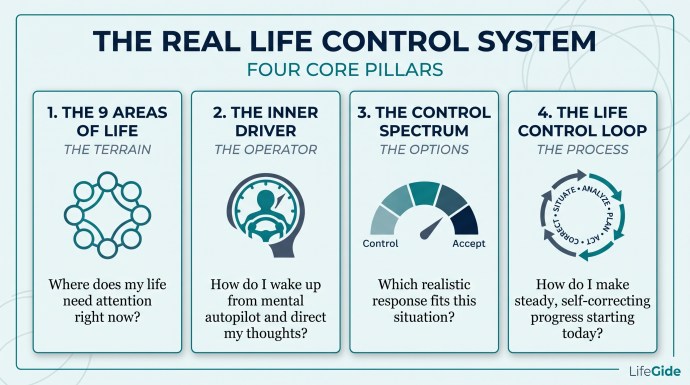 To stop spinning your wheels and take real control of your life, you don’t need more sheer willpower—you need a clear, living-system operating model. The Real Life Control System is built around four straightforward pillars:
The 9 Areas of Life (The Terrain): Where does my life need attention right now?
The Inner Driver (The Operator): How do I wake up from mental autopilot and direct my thoughts?
The Control Spectrum (The Options): Which realistic response fits this situation?
The Life Control Loop (The Process): How do I make steady, self-correcting progress starting today?
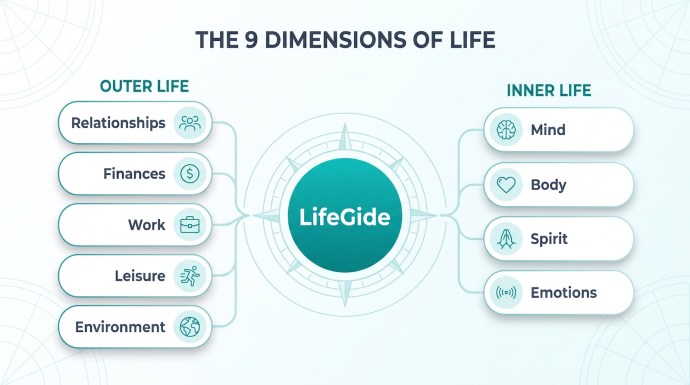
Before you can solve a problem, you have to locate it. Most people get caught in a swirl of overlapping pressures and feel overwhelmed. Instead, we organize your whole life into nine distinct areas so you can pinpoint exactly where friction is coming from—and make sure progress in one area never comes at the blind expense of another.
We look at your life from the outside in, starting with the visible world around you and moving inward:
The Outer Life (What We Notice First)
Relationships: Your family, marriage, friendships, and community connections—learning how to build trust,communicate clearly, and set healthy boundaries without trying to force other people.
Finances: The money you earn, spend, save, and invest—building a clear spending plan, eliminating debt,keeping margins of safety, and freeing yourself from money anxiety.
Work: Your job, business, calling, or primary life work (including caring for your home and family), along with your daily focus and professional growth.
Leisure: Intentional rest, active play, hobbies, and restorative downtime—protecting your free time from constant distraction and digital intrusion.
Environment: Everything surrounding the other areas—your physical home and workspace, your neighborhood,your digital environment (phones, screens, media), and the broader economic, political, and cultural forces around you.
The Inner Life (What Goes On Inside)
Body: Nutritious food, restorative sleep, daily movement, and physical energy as the foundation for everything else.
Mind: Clear thinking, lifelong learning, sound judgment, and the mental tools to solve problems calmly.
Spirit: Faith, prayer, conscience, core values, and connecting to a deeper sense of peace and purpose beyond yourself.
Emotions: Recognizing anger, fear, stress, and joy as valuable signals rather than commands—building emotional resilience so you can stay steady under pressure, respond wisely instead of reacting on impulse, and recover faster from hard blows.
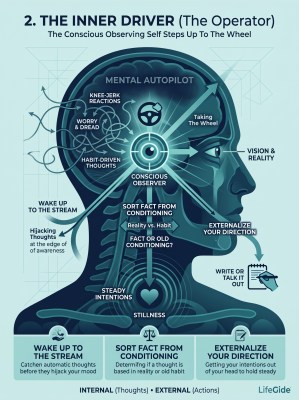 Even the best plan fails if you are running on mental autopilot. Every waking hour, a steady stream of automatic, habit-driven thoughts runs through your mind—quietly triggering worry, procrastination, or knee-jerk reactions before you even notice what happened.
The Inner Driver is your conscious, observing self stepping up to the wheel. Instead of fighting or trying to suppress unwanted thoughts (which only makes them stronger), you learn to:
Wake up to the stream: Catch automatic and preconscious thoughts at the edge of awareness before they hijack your mood or choices.
Sort fact from old conditioning: Question whether a thought is grounded in reality or just an outdated habit.
Externalize your direction: Get your intentions out of your head—writing them down if you process internally, or talking them through if you process verbally—so they hold steady when life gets busy.
 Once you know which area needs attention, the next mistake is trying to force things you have no power to change.
Psychiatrist Viktor Frankl noted that between what happens to you and how you react, there is always a space. In that space lies your freedom to choose. The quickest way to open that space is asking: “Which part of this can I actually control?”
Most advice tells you things are either in your control or out of it. In daily life, reality is far more nuanced. LifeGide uses a 5-level Control Spectrum to give you an honest, practical response to any situation:
Knowing where you are, waking up your Inner Driver, and choosing the right posture on the Control Spectrum gives you clarity. Now you need momentum.
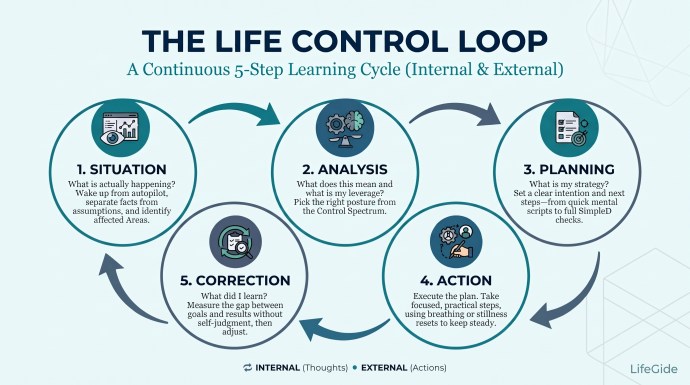 The Life Control Loop is a continuous five-step learning cycle that runs both inside your mind (directing your thoughts) and out in the world (managing daily tasks and major decisions):
Situation: What is actually happening right now? Wake up from autopilot, separate objective facts from fear or assumptions, and identify which of the 9 Areas are affected.
Analysis: What does this mean, and what leverage do I have? Sort deliberate reasoning from habit, and pick the right posture from the Control Spectrum (Control, Manage, Influence, Adapt, or Accept).
Planning: What is my strategy? Set a clear intention and next step—using a quick mental script for everyday friction, or a structured decision checklist (weighing options, pros and cons, the long view, timing, budget, and responsibilities) for major life choices.
Action: Execute the plan. Take focused, practical steps in the real world, using simple breathing or stillness resets when stress spikes so your thinking brain stays online.
Correction: What did I learn? Measure the gap between your goal and your actual results without self-judgment, adjust your course, and feed what you learned back into the next loop.
You do not need to overhaul your entire life by tomorrow morning. Like any living system, your life improves steadily through small, well-aimed adjustments.
The Control Spectrum Sorting Guide: Learn how to sort any overwhelming problem into Control, Manage, Influence, Adapt, and Accept in under 60 seconds.
Read Practical Weekly Guidance on Substack: Join readers getting short, plain-English tools for applying the Real Life Control System in everyday life.
About Buck Lawrimore & Research Backing: Explore the 50 years of real-world practice and peer-reviewed science behind the system.
Before you work harder, make sure you’re climbing toward something you actually want. You can do almost everything right and still end up in the

Arnold Schwarzenegger learned to run his inner state long before he ran California. Here is how you can run yours. In the mid-1970s, Arnold Schwarzenegger was

By Buck Lawrimore, Editor In 1952, a popular pastor named Norman Vincent Peale published a book called The Power of Positive Thinking. The book sold